
Table of Contents
- Introduction
- Quick Comparison Table
- What is Frankincense for Meditation?
- What is Lavender for Meditation?
- Head-to-Head Comparison
- Which should YOU choose?
- How to get started with each?
- FAQs
- Final Recommendation
I. Introduction
You’ve just settled onto your meditation cushion, ready for your morning practice. You reach for your incense, but pause. Should you light frankincense for that deep, grounding spiritual connection? Or lavender for calm, gentle relaxation?
It’s a question meditation practitioners face constantly, and the answer isn’t always obvious. Both frankincense and lavender have been used in spiritual and wellness practices for thousands of years. Both are scientifically proven to affect our nervous system and mental state. Both smell absolutely beautiful.
But they work very differently in your body and mind.
Frankincense tends to deepen meditation, enhance spiritual awareness, and create a sense of sacred space. Lavender soothes anxiety, quiets mental chatter, and gently lulls you into relaxation. One isn’t “better” than the other. They simply serve different meditation intentions and mental states.
In this comprehensive guide, we’ll explore everything you need to know: scent profiles, effects on the nervous system, spiritual traditions, best use cases, scientific research, and how each supports different meditation styles. By the end, you’ll know exactly which aromatic matches your practice, or when to use both.
Quick Answer: Frankincense excels at spiritual meditation, breathwork, and deepening focus. Lavender shines for stress relief, beginners, evening practice, and calming anxiety. Keep reading to discover which supports your specific meditation goals.
II. Quick Comparison Table
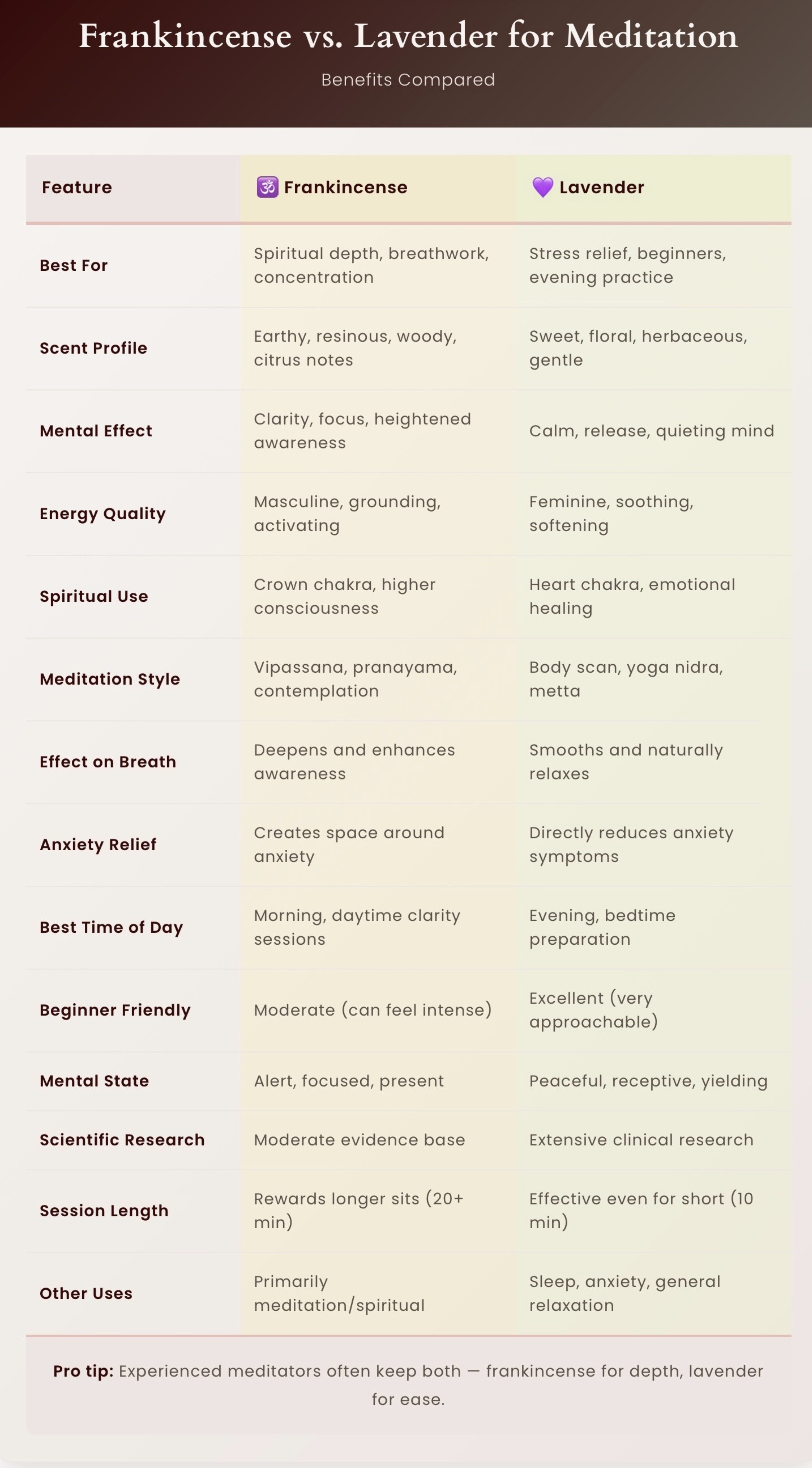
Frankincense vs. Lavender for Meditation
Benefits Compared
III. What Is Frankincense for Meditation?
Frankincense is a natural resin harvested from Boswellia trees, which grow in the arid regions of the Arabian Peninsula, Northeast Africa, and India. But what exactly is a resin?
Tree resin is the plant’s natural defense system. When a Boswellia tree’s bark is deliberately scored or wounded, it secretes a sticky, milky-white sap that hardens when exposed to air. This hardened sap becomes the amber-colored “tears” or chunks of frankincense we recognize. Think of it like the tree’s immune response, similar to how our blood clots when we’re cut. This resin contains concentrated aromatic compounds, protective elements, and the tree’s essential life force.
Frankincense has been harvested this way for over 5,000 years, making it one of humanity’s oldest traded commodities. It was so valuable in ancient times that it was literally worth more than gold. The three wise men bringing frankincense to baby Jesus wasn’t a small gift; it was an offering of immense wealth and spiritual significance.

How It Works:
When frankincense resin is heated or burned, it releases aromatic molecules including alpha-pinene, limonene, and incensole acetate into the air. These compounds don’t just smell pleasant; they actively interact with your brain chemistry.
Alpha-pinene crosses the blood-brain barrier and acts as a bronchodilator, literally opening your airways and making breathing easier and deeper. This is why frankincense has such a powerful effect during breathwork and pranayama practices.
Incensole acetate, unique to frankincense, has been shown in research to activate TRPV3 ion channels in the brain, which influences emotional regulation and reduces anxiety. More importantly for meditation, it appears to stimulate areas of the brain associated with spiritual and transcendent experiences.
On a physiological level, inhaling frankincense slows your heart rate, deepens breathing patterns, and shifts brain wave activity toward alpha and theta states (the brain waves associated with meditative consciousness). Your nervous system literally downshifts from sympathetic activation (stress mode) into parasympathetic dominance (rest and awareness mode). The scent acts as a bridge between your ordinary waking consciousness and meditative states.
The Aromatic Experience:
Frankincense has a complex, multi-layered scent profile that unfolds over time. The initial impression is warm and resinous, almost balsamic, with a slight sweetness. As you continue breathing it, you’ll notice subtle notes: a touch of citrus (from the limonene), hints of wood and spice, even a barely-there peppery quality.
The scent is dense and full-bodied without being heavy or cloying. It has presence and weight in the air. Many people describe frankincense as smelling “ancient” or “sacred,” though that’s partly psychological association with its religious history. The aroma has a penetrating quality; it doesn’t just float on the surface but seems to sink into your awareness.
Unlike light, ephemeral scents that come and go, frankincense persists and builds. It fills a space completely and lingers long after burning ends. This sustained aromatic presence helps maintain meditative focus throughout longer practices. The scent doesn’t fade into the background; it remains gently present, supporting your awareness without demanding attention.
For most people, frankincense smells grounding and centering rather than relaxing. It creates alertness rather than drowsiness. If you’re familiar with the smell of Catholic church incense or traditional temple ceremonies, that’s frankincense (often blended with myrrh). The scent signals to something deep in the psyche: “Something sacred is happening here.”
Traditional and Spiritual Uses:
Frankincense’s spiritual resume is extensive and cross-cultural. Ancient Egyptians burned frankincense in their temples and used it in the mummification process, believing it helped souls transition to the afterlife. It was a key ingredient in the holy anointing oil described in the Hebrew Bible. Catholic and Orthodox Christian churches have burned frankincense during Mass for two millennia. Islamic traditions use it for purification. Buddhist monasteries in Tibet and beyond burn it during meditation and prayer.
In yoga traditions, frankincense is associated with the crown chakra (Sahasrara), the energy center connected to higher consciousness, spiritual awakening, and connection to the divine or universal awareness. Pranayama practitioners specifically choose frankincense because its bronchodilating properties support deep, controlled breathing practices.
Contemplative traditions across religions use frankincense to create sacred space, marking the boundary between ordinary time and ritual time. The act of burning frankincense signals: “We are now entering a different quality of awareness.”
In energy healing and metaphysical practices, frankincense is believed to raise vibration, clear heavy or stagnant energy, and create a protective field around meditation spaces. Whether you interpret this literally or metaphorically, the practical effect remains: burning frankincense changes the felt quality of a space, making it feel more conducive to inner work.
Modern meditators use frankincense for deepening concentration practices, enhancing visualization work, supporting transcendent or mystical experiences, and creating consistency in their practice through ritual and scent anchoring.
Good Living Is Glam Frankincense Products:
Our Nourish Your Energy Herbal Incense Jar features frankincense as a cornerstone ingredient, blended thoughtfully with rose (for heart-opening) and lavender (for ease). This combination offers frankincense’s spiritual depth and mental clarity while adding softness and emotional support. The blend is perfect for practitioners who want frankincense’s benefits without the intensity of burning pure resin.
For those building meditation rituals, our New Beginnings Herbal Palo Santo Kit includes sacred woods and resins that work synergistically with frankincense energy, helping you establish consistent practice through ceremony and intention.
IV. What Is Lavender for Meditation?
Lavender is a flowering herb native to the Mediterranean, beloved worldwide for its instantly recognizable floral scent and profound calming properties. While frankincense has religious and ceremonial roots, lavender’s meditation history comes primarily from herbalism and aromatherapy traditions, such as folk medicine practices where plants were used to heal both body and mind.

How It Works:
Lavender contains linalool and linalyl acetate, aromatic compounds proven to reduce cortisol (stress hormone) levels and increase parasympathetic nervous system activity. Translation: your body physically relaxes. Studies show that inhaling lavender reduces anxiety scores, slows racing thoughts, and helps transition from alert wakefulness into calm receptivity, the perfect mental state for meditation. Unlike frankincense which creates focus, lavender creates softness.
The Aromatic Experience:
Lavender is sweet, floral, herbaceous, and immediately soothing. The scent is gentle rather than intense, creating a soft aromatic backdrop that doesn’t demand attention. Most people find it inherently pleasant and comforting—it’s the scent of calm itself. Where frankincense announces “something sacred is happening,” lavender whispers “it’s safe to let go now.”
Traditional and Spiritual Uses:
While lavender doesn’t have the ceremonial gravitas of frankincense, it has deep roots in healing practices. European herbalists used lavender for nervous disorders, insomnia, and “hysteria” (anxiety, in modern terms). In contemporary meditation and yoga spaces, lavender is the go-to for restorative practices, yin yoga, yoga nidra, body scans, and any practice focused on releasing rather than concentrating. It’s also beloved for bedtime meditation and sleep preparation.
Good Living Is Glam Lavender Products:
Our EverKindle Kindle & Simmer Herbal Incense combine lavender’s calming properties with warming herbs and flowers for an emotionally supportive meditation. The Nourish Your Energy Jar also features lavender as a key component, blended to support relaxed yet present awareness.
V. Head-to-Head Comparison
Let’s get specific about how these two aromatics actually perform across the factors that matter for meditation practice:
A. Scent Profile & Sensory Experience
Frankincense:
The scent is complex, earthy, and resinous with hints of citrus, wood, and spice. It’s energy can best be described as grounding, centering, solid. The aroma doesn’t fade quickly; it builds and sustains throughout your practice. Some people find it powerfully transportive, immediately shifting them into “sacred space” mindset. Others find it too strong or ceremonial for casual daily meditation. It’s definitely a presence in the room.
Lavender:
The scent is simple, sweet, floral, and instantly familiar. It’s a feminine energy: soft, nurturing, gentle. The aroma is lighter and more ephemeral, creating atmosphere without dominating. Almost universally pleasant; very few people dislike lavender. It’s approachable and comforting rather than dramatic. Perfect for those who want subtle aromatic support without the incense feeling like the main event.
Winner: Tie–Completely depends on your sensory preferences and what “meditation” means to you.

B. Effect on Mental State
Frankincense:
Creates clarity, focus, and heightened awareness. Your mind becomes sharper and more present rather than drowsy. Perfect for concentration practices, insight meditation, or any technique requiring sustained attention. The effect is consciousness-expanding—you feel more awake to subtle internal experiences. Some practitioners report enhanced visualization abilities and deeper access to intuition. The mental quality is alert yet calm, focused yet spacious.
Lavender:
Creates softness, release, and gentle letting-go. Your mind becomes quieter and less reactive rather than more focused. Perfect for relaxation-based practices, body awareness, or releasing anxiety and stress. The effect is nervous-system-soothing. You feel safe enough to stop controlling. Some practitioners report easier access to emotions and reduced rumination. The mental quality is peaceful, receptive, and yielding.
Winner: Depends on meditation style–Frankincense for concentration practices, lavender for relaxation practices.
C. Spiritual & Energetic Qualities
Frankincense:
Associated with crown chakra, higher consciousness, connection to divine or universal awareness. Creates a sense of sacredness and ceremony. Historically used to “elevate vibration” and facilitate prayer or spiritual communion. Many practitioners feel frankincense helps them access deeper meditative states or transcendent experiences. It’s the scent of going inward and upward simultaneously, toward both self and something greater.
Lavender:
Associated with heart chakra, emotional healing, self-compassion, and inner peace. Creates a sense of safety and gentleness. Historically used for emotional release and nervous system healing. Many practitioners feel lavender helps them soften around difficult feelings or practice self-kindness. It’s the scent of coming home to yourself; of being held and allowed to simply be.
Winner: Frankincense–If spiritual depth is your primary meditation goal.

D. Best for Different Meditation Styles
Frankincense:
- Breathwork and pranayama
- Vipassana or insight meditation
- Chakra meditation
- Transcendental meditation
- Contemplative prayer
- Visualization practices
- Long meditation sessions (30+ minutes)
- Advanced practitioners seeking depth
- Morning meditation for mental clarity
- Lavender:
- Body scan meditation
- Loving-kindness (metta) practice
- Yoga nidra
- Restorative yoga
- Guided relaxation
- Sleep meditation
- Short sessions (10-15 minutes)
- Beginners learning to meditate
- Evening meditation for winding down
Winner: Both–They excel at completely different meditation approaches.
E. Effect on Breathing
Frankincense:
Research shows frankincense actively deepens and slows breath. The aromatic compounds seem to enhance respiratory awareness, making it easier to notice subtle breath sensations. Many pranayama practitioners specifically choose frankincense because it makes breathwork feel more natural and less effortful. Your breath becomes your anchor more easily. This is powerful for breath-focused meditation techniques.
Lavender:
Lavender smooths and softens breathing patterns, reducing that shallow, anxious chest breathing. Your breath becomes more diaphragmatic and relaxed without requiring conscious effort. This is perfect for body-based practices where you want breath to happen naturally in the background while you focus attention elsewhere. Less about breath awareness, more about breath ease.
Winner: Frankincense–For breath-centered practices; Lavender for effortless breathing.
F. Anxiety & Stress Relief
Frankincense:
It helps you relate to anxiety differently, observing it with more space and perspective rather than dissolving it. You’re still aware of stress, but less identified with it. This can be powerful for insight practices but isn’t always comforting when you’re overwhelmed. Frankincense says “be present with whatever arises,” which isn’t always what an anxious nervous system needs.
Lavender:
Directly reduces anxiety symptoms at the physiological level. Heart rate slows, muscles relax, cortisol drops. You feel genuinely calmer, not just more aware of your anxiety. This is exactly what you want when you’re stressed, overwhelmed, or can’t quiet your mind. Lavender says “you’re safe now, you can rest,” which is precisely what an activated nervous system needs to hear.
Winner: Lavender–Hands down, for acute anxiety relief.
G. Best Times of Day
Frankincense:
Morning meditation is its sweet spot. The clarity and focus it creates align perfectly with starting your day with intention. It’s also excellent for afternoon practices when you need to reset and refocus without becoming drowsy. Less ideal for evening unless you’re doing active practice as frankincense energizes subtle awareness rather than preparing you for sleep.
Lavender:
Shines in evening practice. The relaxation it creates helps you transition from day to night, release accumulated stress, and prepare for restful sleep. It’s also wonderful mid-day when you need to decompress and soften. Fine for morning if you tend toward anxiety or need extra gentleness to begin your day, though it might feel too sedating for some people’s morning practice.
Winner: Frankincense for morning, Lavender for evening.

H. Beginner-Friendliness
Frankincense:
Can feel intense or ceremonial for meditation newcomers. The strong scent and spiritual associations might feel like “too much” when you’re just trying to sit still for ten minutes. Some beginners find frankincense helps them take meditation seriously and create ritual, but others find it intimidating or overly formal. The focused mental state it creates is wonderful once you know what you’re doing, but might not provide the softness beginners often need.
Lavender:
Exceptionally beginner-friendly. The familiar, pleasant scent puts people at ease immediately. No intimidation factor, no “am I doing this right?” uncertainty. Lavender’s anxiety-reducing properties help with the most common beginner struggle—the racing mind. It makes meditation feel accessible, safe, and gentle rather than serious or difficult. Most meditation teachers use lavender when introducing new students to practice.
Winner: Lavender–Significantly easier for beginners.
I. Scientific Research & Evidence
Frankincense:
Multiple studies show frankincense reduces anxiety and depression symptoms, though less research exists compared to lavender. The compound boswellic acid shows anti-inflammatory effects on the brain. Research on Boswellia serrata demonstrates positive effects on memory and cognition. Several studies specifically examine frankincense’s effect on meditative states, showing increased alpha brain waves (associated with relaxed alertness). The research is compelling but less extensive than lavender.
Lavender:
Extensively researched with hundreds of studies confirming anxiolytic (anti-anxiety) effects. Clinical trials show lavender aromatherapy reduces cortisol, improves sleep quality, decreases heart rate, and lowers anxiety scores across multiple populations. It’s one of the most scientifically validated aromatherapy applications. The evidence base is robust, consistent, and widely accepted in both complementary and conventional medicine.
Winner: Lavender–Far more research supporting its claims.
J. Versatility & Other Uses
Frankincense:
Very meditation and spirituality-specific. While it has other traditional uses (skincare, inflammation, immune support when used as essential oil), the aromatic incense form is really optimized for contemplative practice. It’s a specialist–amazing at what it does, but not particularly versatile beyond meditation, prayer, and sacred space clearing.
Lavender:
Incredibly versatile. Beyond meditation, you can use lavender aromatherapy for sleep, anxiety relief throughout the day, headache relief, creating calm in chaotic environments, helping children relax, freshening linens and spaces, and general stress management. The same bundle or jar that supports your meditation can also help you fall asleep, calm down after a difficult day, or create peaceful atmosphere anytime. It’s a generalist.
Winner: Lavender–Significantly more versatile.

VI. Which Should YOU Choose?
The honest answer depends entirely on what you’re trying to achieve in your meditation practice. Here’s how to decide:
Choose Frankincense If You:
You’re drawn to the spiritual depths of meditation and want to access transcendent or mystical experiences. Frankincense is perfect if you practice breathwork, concentration techniques, or insight meditation where mental clarity matters. Maybe you’re an experienced meditator looking to deepen your practice, or you resonate with the ceremonial aspect of burning sacred resins. If you meditate in the morning to set intentions for your day, or you want that feeling of stepping into sacred space the moment you light your incense, frankincense is calling you. You’re comfortable with intensity and want an aroma that commands presence and focus.
Perfect for: Experienced practitioners, breathwork enthusiasts, morning rituals, spiritual seekers, concentration practices, pranayama, those who want ceremony and depth.
Choose Lavender If You:
You’re seeking relief from anxiety, stress, or an overactive mind, and want meditation to feel gentle and accessible. Lavender is ideal if you’re new to meditation and need support quieting mental chatter, or if you practice in the evening to transition into rest. Maybe you do body-based practices like yoga nidra or body scans where softness matters more than focus. If you want subtle aromatic support that doesn’t demand attention, or you’re sensitive to strong scents, lavender will serve you beautifully. You appreciate gentleness and want an aroma that soothes rather than activates.
Perfect for: Beginners, evening meditation, anxiety relief, restorative practices, sleep preparation, yin yoga, body awareness, those seeking gentleness and ease.
The Hybrid Approach (Recommended for Experienced Practitioners):
Here’s what many long-term meditation practitioners discover: different days call for different aromatics.
Use frankincense when you want to go deep—for weekend morning sits, new moon intentions, or those days when you crave spiritual connection and mental clarity.
Use lavender when you need softness—after difficult days, for evening wind-down, or when your nervous system needs soothing more than your spirit needs elevating.
Some practitioners even combine them, creating a custom blend that offers both focus and relaxation, grounding and gentleness. The two work synergistically—frankincense provides the container and clarity, lavender provides the softness and ease.
This gives you flexibility to match your aromatic to your current state and intention. Some practices call for the sacred depth of frankincense. Others call for lavender’s tender embrace.
The best approach? Start with whichever resonates most right now, then experiment with the other as your practice evolves. Your meditation journey isn’t static, so your aromatic support shouldn’t be either.

VII. How to Get Started With Each
Starting Your Practice with Frankincense:
Begin with small amounts as frankincense can be quite potent. If using resin on charcoal, start with a piece the size of a pea. If burning in a bundle or jar blend, use less than you think you need. Practice before your meditation session so the scent establishes before you sit. Notice how the aroma affects your breath and mental state. Give yourself three or four sessions to truly understand frankincense’s effect—it’s subtle and builds over time.
Pair frankincense with practices that match its energy: breath awareness, chakra meditation, contemplative sitting, or any technique requiring sustained focus. Set aside at least 20 minutes–frankincense rewards longer sessions. Create a small ritual around lighting it to signal to your mind that practice is beginning.
Recommended Starting Point: Our Nourish Your Energy Herbal Incense Jar includes frankincense blended with rose and lavender, offering frankincense’s spiritual depth with additional aromatic support. This is perfect for experiencing frankincense without the intensity of pure resin. The blend is forgiving and versatile for different meditation styles.
Starting Your Practice with Lavender:
Lavender is wonderfully forgiving, making it hard to use “too much” and nearly impossible to dislike. Begin with whatever amount feels right. Light your lavender incense 5-10 minutes before meditation, letting the scent fill your space. Settle into your seat and notice how quickly your shoulders drop, your jaw softens, your breath deepens. Lavender works fast.
Pair lavender with body-based practices: body scans, progressive relaxation, gentle breathwork, or loving-kindness meditation. Even five minutes with lavender can shift your state significantly. If you’re new to meditation entirely, combine lavender with guided meditation recordings—the scent plus voice guidance creates a supportive container for learning.
Recommended Starting Point: Our Nourish Your Energy Herbal Incense Jar includes lavender blended with rose, sage and cedar, offering frankincense’s spiritual depth with additional aromatic support. The combination of lavender and rose creates a heart-centered, emotionally supportive experience ideal for beginners or anyone seeking gentleness. Light, breathe, soften, and begin.
VIII. Frequently Asked Questions
Can I use both frankincense and lavender together?
Absolutely! Many experienced practitioners combine them for a balanced meditation experience as frankincense provides focus and spiritual depth while lavender adds ease and nervous system support. You can either burn them simultaneously (one frankincense resin piece plus lavender bundle, or use a blend like our Nourish Your Energy Jar that contains both) or burn them sequentially (frankincense at the start for focus, lavender midway through for softening).
Which one is better for anxiety during meditation?
Lavender, without question. If meditation feels difficult because your mind races or anxiety surfaces when you sit still, lavender will help significantly more than frankincense. Frankincense helps you observe anxiety; lavender helps reduce it. Start with lavender until your practice feels more easeful, then explore frankincense if you’re curious about deeper states.
Does frankincense make you sleepy?
No, quite the opposite. Frankincense creates alert, focused awareness rather than drowsiness. If you’re falling asleep during meditation and want to stay awake, frankincense helps. If you’re too activated and need to settle, choose lavender instead.
Which is more “traditional” for meditation?
Frankincense has older ceremonial roots. It appears in ancient spiritual texts and has been burned in temples for millennia. Lavender comes more from herbalism and folk medicine traditions. Both are “traditional” in different contexts. For spiritual/religious meditation practices, frankincense carries more historical weight. For wellness-focused mindfulness, either works beautifully.
Can beginners use frankincense?
Yes, though lavender is gentler for learning. If you’re drawn to frankincense’s spiritual qualities, start with a blend (like our Nourish Your Energy Jar) rather than pure resin. This gives you frankincense’s benefits with less intensity. As you become more comfortable meditating, you can explore pure frankincense if desired.
Which one smells better?
This is entirely subjective. Most people find lavender immediately pleasant and comforting, so it’s a universally loved scent. Frankincense is more polarizing; people either love its ancient, resinous character or find it too strong/unfamiliar. The “better” scent is whichever one you personally enjoy breathing for 20+ minutes.
Do these actually improve meditation or is it just placebo?
Both placebo effect and genuine physiological impact are at play. The aromatic compounds in both frankincense and lavender demonstrably affect your nervous system, brain waves, and hormone levels—that’s measurable science. But the ritual and intention you bring to using them amplifies those effects. Even if it were “just” placebo (it’s not), the psychological benefit is real and valuable. Your brain doesn’t distinguish between placebo and pharmacological effects when both create genuine state changes.
Can I meditate without any incense?
Of course! Aromatics are supportive tools, not requirements. Many traditions practice without any scent at all. Frankincense and lavender simply offer additional support for creating meditative states and signaling to your brain that practice is beginning. Think of them as training wheels—helpful while you’re learning, optional once you’re established, or lovely additions even for experienced practitioners who simply enjoy them.
Which is safer for daily use?
Both are safe for daily aromatherapy use. Ensure proper ventilation regardless of which you choose. If you have respiratory sensitivity, use less or opt for shorter burn times. Lavender is slightly gentler on sensitive systems, but neither poses risks when used reasonably. Always listen to your body—if either creates irritation or headaches, reduce the amount or discontinue use.
Can I use these for other types of meditation besides sitting practice?
Yes! Frankincense is excellent for walking meditation, breathwork sessions, yoga practice, or any active meditation technique. Lavender works beautifully for lying-down practices (though be aware you might fall asleep—that’s okay!), movement meditation, tai chi, or any gentle somatic practice. Both support any practice where you’re working with awareness, presence, and intention.

IX. Final Recommendation
Here’s what we’ve learned from years of supporting meditation practitioners: there’s no universally superior aromatic. Both frankincense and lavender are powerful, effective, beautiful tools for supporting meditation—they simply shine in different contexts and serve different needs.
Your best path forward depends on your meditation goals:
If you’re seeking spiritual depth, enhanced concentration, breathwork support, or ceremonial practice, frankincense is calling you. If you’re working with anxiety, beginning your meditation journey, practicing in the evening, or need gentle nervous system support, lavender will serve you beautifully.
But here’s our deepest wisdom from Gina, our founder and certified aromatherapist: Your practice will evolve, and your aromatic needs will evolve with it.
The meditator you are today might crave lavender’s gentleness. The meditator you become in six months might be ready for frankincense’s depth. Or vice versa. Or you’ll discover you want both, used strategically for different practices and states.
At Good Living Is Glam, we offer both precisely because we honor this evolution. We’ve watched beginners start with lavender, discover confidence in their practice, then add frankincense for depth. We’ve seen stressed professionals start with frankincense for morning clarity, then add lavender for evening release.
Ready to deepen your meditation practice? Explore our complete collection of frankincense and lavender incense blends, all ethically sourced and handcrafted with intention. Our Nourish Your Energy Jar offers both aromatics in one balanced blend if you’re curious about experiencing them together.
Have questions about which specific product suits your meditation style? We’re here to help you choose. Because the most effective meditation aromatic isn’t the one that’s theoretically “best”, it’s the one that helps you show up to your cushion, your breath, and yourself with presence and ease.
Your meditation journey is uniquely yours. We’re honored to support it.